








This journal uses Open Journal Systems 3.1.2.0, which is open source journal management and publishing software developed, supported, and freely distributed by the Public Knowledge Project under the GNU General Public License.
SUKUK: International Journal of Banking, Finance, Management and Business utilizes Open Journal Systems (OJS), an open-source journal management and publishing platform developed by the Public Knowledge Project (PKP). The platform facilitates the administration of scholarly manuscripts from initial submission through editorial assessment, peer review, manuscript editing, issue management, and online publication.
The publication system provides an integrated digital environment through which authors, editors, reviewers, and production personnel can undertake their respective responsibilities. It supports manuscript tracking, editorial correspondence, reviewer assignments, document management, publication preparation, and the maintenance of published journal archives.
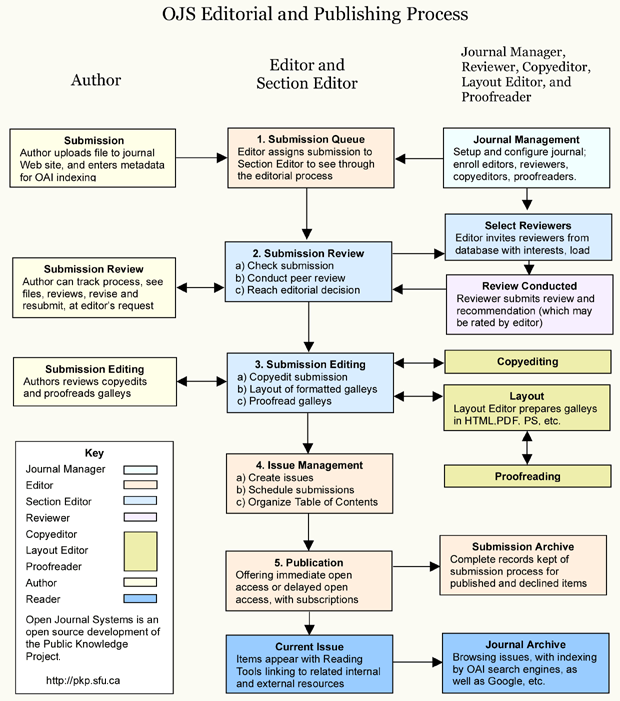
The diagram below illustrates the general editorial and publishing functions supported by the OJS platform. It represents the technical structure of the publishing system rather than the organizational hierarchy or specific editorial appointments of SUKUK. Accordingly, functional designations such as Journal Manager, Section Editor, Layout Editor, and Proofreader describe roles within the OJS publishing framework and do not necessarily indicate separately appointed positions within the journal.
For information regarding SUKUK's actual editorial responsibilities, double-blind peer-review procedures, and decision-making authority, readers should consult the journal's Publication Process, Managing Editors, and Editorial Team pages.
Manuscript Submission
The publication process begins when an author submits a manuscript electronically through the journal's OJS platform. Authors are required to provide the manuscript file and relevant submission metadata, including the article title, abstract, keywords, author information, and other supporting documentation where applicable.
The system records the submission and enables authors to monitor its progress throughout the editorial process. Authors may also receive editorial notifications, access reviewers' comments communicated through the editorial office, upload revised manuscripts, and participate in subsequent editing and proofreading stages.
This electronic submission mechanism helps maintain an organized record of manuscript correspondence, documentation, and editorial activities.
Submission Queue and Editorial Assignment
Following submission, manuscripts enter the OJS submission queue, where they become available to authorized editorial personnel for preliminary assessment and assignment.
In the general OJS workflow illustrated in the diagram, the Editor assigns a manuscript to a Section Editor who oversees its progress through the editorial process. Within SUKUK, these functions are undertaken according to the journal's established editorial arrangements, under the supervision of the Editor-in-Chief and with administrative support from the Managing Editors.
The submission queue enables authorized editors to access manuscript information, monitor submission status, coordinate editorial correspondence, and initiate the necessary assessment procedures.
The assignment of technical responsibilities within OJS does not independently confer academic decision-making authority. Editorial decisions remain governed by SUKUK's official Publication Process and editorial policies.
Submission Review and Peer-Review Management
The submission review stage provides the technical facilities through which manuscripts are examined, reviewers are invited, review reports are collected, and editorial decisions are communicated.
The system enables authorized editorial personnel to select suitable reviewers based on their scholarly expertise and subject-area relevance. Invited reviewers may access the manuscripts assigned to them and submit their assessments and recommendations through the platform.
OJS supports the administration of different peer-review arrangements. SUKUK specifically follows a double-blind peer-review process involving at least two independent expert reviewers, as explained in its official Publication Process.
The system facilitates communication between the editorial office and reviewers while supporting the confidentiality of the review process. Reviewers' recommendations are considered by the editorial team, but the system itself does not determine whether a manuscript should be accepted or rejected.
Authors may be requested to revise their manuscripts following peer review. Revised submissions can be uploaded through OJS and subjected to further editorial assessment or additional review when necessary.
Submission Editing and Production
After a manuscript has been formally accepted, the OJS publication workflow supports the preparation of the article for publication.
As shown in the diagram, this stage involves three principal activities:
Copyediting: The accepted manuscript is examined for language accuracy, grammatical consistency, clarity, referencing, and conformity with the journal's editorial and formatting requirements.
Layout Editing: The manuscript is prepared in the required publication formats, such as PDF and HTML, according to the journal's technical capabilities and production arrangements.
Proofreading: The formatted article is checked to identify and correct typographical errors, formatting inconsistencies, and other production-related issues before publication.
The diagram identifies Copyeditor, Layout Editor, and Proofreader as distinct publishing functions. These responsibilities may be performed by designated editorial personnel or appropriately assigned production staff according to the journal's actual organizational arrangements.
Within SUKUK, language and copyediting activities are supported by the journal's designated Language and Copy Editor, while other production responsibilities are coordinated through its editorial and publication procedures.
Issue Management
The issue management stage enables authorized editorial personnel to organize accepted articles into journal issues and prepare them for publication.
Through the OJS platform, editorial personnel can create new issues, schedule accepted submissions, arrange article order, organize the table of contents, and manage relevant publication information.
This functionality supports the journal's publication schedule and provides an organized structure for the presentation of published research.
Decisions concerning article inclusion, issue allocation, and publication scheduling are made in accordance with SUKUK's editorial policies and under the appropriate editorial oversight.
Online Publication and Journal Archive
Following completion of the necessary editorial and production stages, articles are published electronically through the journal's website.
The OJS platform supports the presentation of published articles, including their titles, abstracts, authorship details, bibliographic metadata, and available full-text publication files.
The system also maintains a journal archive through which readers can browse previous issues and access published articles.
Where appropriate metadata and technical configurations are provided, OJS can support the discoverability of journal content by scholarly search engines, indexing services, and other academic information systems.
The publication and archiving functions are intended to facilitate the accessibility, dissemination, and preservation of the journal's scholarly output.
Functional Roles within the OJS Publication System
The accompanying diagram distinguishes several functional roles involved in the operation of a scholarly publishing platform. Their general responsibilities are summarized below.
|
OJS Functional Role |
Responsibilities |
|
Author |
Submits manuscripts, provides metadata, responds to editorial requests, uploads revisions, and reviews publication proofs where requested. |
|
Journal Manager |
Administers journal settings, user accounts, publishing configurations, and other system-management functions. |
|
Editor |
Oversees the editorial workflow, assigns manuscripts, coordinates editorial assessment, and manages publication decisions. |
|
Section Editor |
Handles assigned manuscripts, coordinates reviewer assignments and review reports, and supports editorial assessment. |
|
Reviewer |
Independently evaluates submitted manuscripts and provides scholarly assessments and recommendations. |
|
Copyeditor |
Reviews accepted manuscripts for language, style, consistency, and editorial presentation. |
|
Layout Editor |
Prepares accepted manuscripts in the journal's designated publication formats. |
|
Proofreader |
Checks publication proofs for typographical, formatting, and production-related errors. |
|
Reader |
Accesses and reads articles published through the journal platform. |
These designations describe the functional components of the OJS publishing environment. They should not be interpreted as a separate list of editorial appointments or as evidence that each function is performed by a different individual within SUKUK.
Relationship Between the Publication System and Editorial Governance
The Publication System and Publication Process serve complementary but distinct purposes.
The Publication System explains the digital infrastructure and operational functions available through OJS, including manuscript management, editorial communication, review administration, production, issue management, and archiving.
The Publication Process, by contrast, describes the editorial procedures specifically adopted by SUKUK, including its administrative screening, Editor-in-Chief oversight, independent double-blind peer review, manuscript revision, editorial decision-making, and publication preparation.
Although OJS provides the technical infrastructure for these activities, scholarly assessments and editorial decisions are undertaken by the journal's authorized editorial personnel rather than determined automatically by the platform.
SUKUK maintains this distinction to ensure transparency, accountability, and consistency between its publishing infrastructure and editorial governance.
Note: The accompanying OJS diagram is a general illustration of publishing-system functionality.